

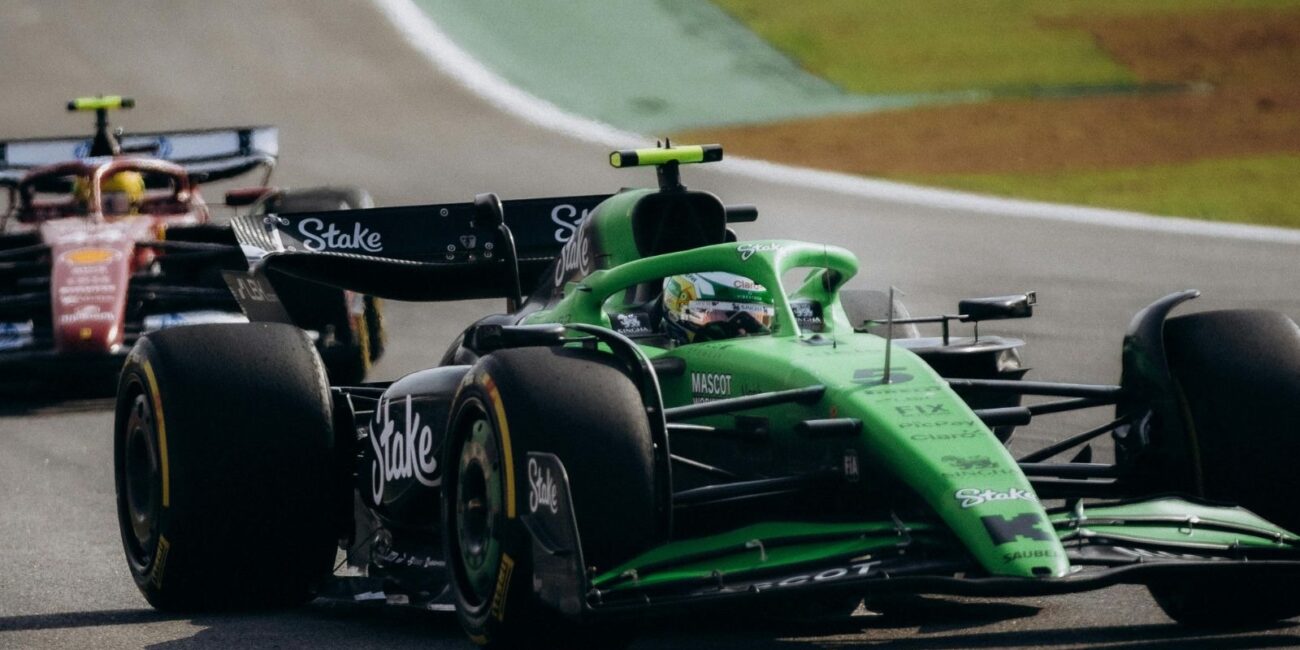
One team, two names. What looked confusing at first was that Formula One operated under different laws across the world.
If you followed the 2024 Formula One season closely, you probably noticed something unusual. The team once known as Alfa Romeo didn’t always appear under the same name. One weekend it was running under its Stake branding, while in others, it appeared as Kick Sauber, reflecting how the same team identity was adapted depending on local regulations. At first glance, it didn’t make much sense. In reality, it was a calculated response to the global nature of Formula One.
What appeared to be a branding quirk was actually a direct result of how the sport intersects with national laws, commercial partnerships and a team in the middle of a long-term transformation.
A team caught between global reach and local laws
When the Sauber-run outfit rebranded as Stake F1 Team ahead of the 2024 season, it marked the start of a short but complex era. Stake, a global betting and entertainment brand, had taken naming rights, replacing Alfa Romeo as title sponsor. But unlike traditional sponsors, Stake’s category created immediate complications.
Different countries on the Formula One calendar apply different rules to gambling advertising. In some markets, promotion of betting platforms is restricted or banned outright. As a result, the team could not run the same identity everywhere.
As explained by team representative Alessandro Alunni Bravi during the launch period, the approach was straightforward in principle but unusual in execution. Where Stake branding was not permitted, the team would compete under an alternative identity using “Kick,” a streaming platform linked to the same ownership group.
For example, in races held in countries with strict gambling advertising rules, such as certain European jurisdictions, the team appeared under the Kick branding instead of Stake. This wasn’t a one-off adjustment, but a repeated pattern throughout the season, depending on local regulations.
This wasn’t entirely new. Even in 2023, the team had already alternated between “Alfa Romeo F1 Team Stake” and “Alfa Romeo F1 Team Kick” depending on the race location. By 2024, that dual identity became central to the team’s public image.
Why “Kick Sauber” existed at all
The naming workaround was more than cosmetic. It reflected how Formula One teams must balance FIA regulations with local legal frameworks.
From a regulatory standpoint, the team’s official entry name included both identities. The official entry combined both identities under the name “Stake F1 Team Kick Sauber,” while “Sauber” remained the constructor. In practice, “Stake” was used as the primary commercial identity where permitted, and “Kick” was used in markets where gambling sponsorship was restricted. This dual structure allowed the team to remain compliant without sacrificing sponsor value.
And it says a lot about how Formula One now operates.
It also highlighted a broader reality within modern Formula One. Teams are global businesses operating across more than 20 jurisdictions in a single season. Each race weekend brings a new legal environment, particularly when it comes to advertising categories like alcohol, tobacco and now gambling.
From a regulatory standpoint, Formula One itself does not impose restrictions on sponsor categories like gambling. Instead, teams must comply with the advertising laws of each host country. That distinction is important because it means branding decisions are often made race by race, rather than centrally by the sport.
That tension between global exposure and local restriction is not new to the sport. Formula One navigated similar challenges during the tobacco sponsorship era, when teams would run alternative branding in countries with strict advertising laws. Stake’s situation was a modern version of the same problem.
How Stake’s global model mirrors its F1 strategy
To understand why this approach works, it helps to look at how the brand itself operates. Stake does not present a single uniform product across every market. Instead, it adjusts its offering depending on local regulation, user access and the legal framework it operates within.
In some countries, the platform operates primarily as a casino, while in others it leans more toward sportsbook-style offerings. That split depends entirely on what is permitted within each jurisdiction, and it shapes how users interact with the platform from one region to another.
A clear example of this is Stake.us, which operates under a sweepstakes model in the United States rather than as a traditional real-money casino. Instead of direct gambling, users engage with virtual currencies, with separate systems for standard play and redeemable rewards. This allows the platform to function within U.S. regulations while still offering a similar overall experience.
That flexibility is a core part of the model. Features, rewards and overall experience can vary depending on what is allowed in a specific market. Rather than forcing a single structure everywhere, the platform adapts to fit each environment it enters.
The same logic applies in Formula One. What you see on track is simply a reflection of that approach, with branding shifting depending on local restrictions while the underlying operation remains the same.
In other words, the dual identity seen on track is not unusual for the business. It is a direct extension of how it already operates off it.
Why Stake.us plays a different game in the United States
The United States adds another layer to this story. Rather than operating as a traditional online casino, Stake runs a sweepstakes-based model through its U.S. platform, as can be seen on this page.
This system separates gameplay into two currencies. Gold Coins are used for standard play and have no real-world value. Stake Cash can be redeemed under specific conditions once requirements are met. Because of this structure, the platform operates within sweepstakes law rather than conventional gambling regulation.
New users typically enter this system through packages that combine large volumes of Gold Coins with smaller amounts of Stake Cash, which can only be redeemed once playthrough requirements are met. That balance between entertainment currency and redeemable value is central to how the model works in practice.
It is a workaround that reflects the same thinking seen in Formula One. Instead of forcing a single model into every market, the brand adjusts its structure to remain compliant while maintaining user engagement.
That adaptability is central to understanding both the platform and its presence in the sport.
A team already in transition
While the naming changes grabbed attention, they were only part of a bigger story. The Stake era was always intended as a bridge between two identities.
The team had already moved through multiple transformations over the past two decades, from BMW Sauber to Alfa Romeo and then to Stake. Each shift reflected changes in ownership, funding and long-term direction.
By 2024, it was clear that another transition was coming. Audi had already confirmed its entry into Formula One, with plans to take full control of the Sauber operation and establish a factory team from 2026.
As a result, the Stake and Kick identities were temporary by design.
Performance pressures behind the branding
Off-track complexity was matched by on-track challenges. The team entered 2024 off the back of a difficult period, finishing ninth in the constructors’ standings in 2023 and struggling to keep pace with midfield rivals.
Despite early promise under the 2022 regulations, development had stalled. From mid-2022 through the end of 2023, the team scored just 13 points, fewer than any of its direct competitors.
At that level, everything tightens. Even small mechanical differences, such as clutch setups in Formula 1 cars, can influence how effectively drivers manage power and traction across a race weekend.
Drivers Valtteri Bottas and Zhou Guanyu remained in place, tasked with extracting more from a car that technical director James Key described as more ambitious but still a work in progress, as the team worked to balance safety with outright pace.
The branding conversation may have dominated headlines, but internally, the focus was on rebuilding competitiveness before the Audi takeover.
From Kick Sauber to Audi in 2026
By April 2026, the picture has changed again. The team now competes as Audi, marking the end of the Sauber naming lineage that dates back to 1993.
The new era brings a fresh driver pairing in Nico Hülkenberg and Gabriel Bortoleto, along with increased resources and long-term ambition. After scoring 70 points in 2025 and showing signs of progress, the team enters 2026 with momentum, even if results still place it in the lower midfield.
Audi’s target is clear. The project is built around a long-term plan to challenge for championships by the end of the decade, with 2030 identified as a realistic milestone.
Early results have been mixed. Reliability issues and power unit development remain ongoing challenges. Leadership changes have also shaped the direction of the project, with Jonathan Wheatley stepping into the team principal role during the transition before departing early in the 2026 season, leaving Mattia Binotto to take on greater responsibility as the structure continues to evolve.
The Stake period was part of that same process.
Running as Stake in some markets and Kick in others came down to managing commercial demands alongside regulatory limits, while the team moved toward Audi’s full takeover. It was a practical solution to the environment in which Formula One operates.
The naming changes were not a gimmick. They were a direct response to how Formula One operates across multiple legal systems, where teams must constantly balance global sponsorship deals with local restrictions. What looked unusual on the surface was simply the modern reality of running a team in a sport that spans the world, with one operation adapting its identity to fit every market it enters.