

The $9.5 Billion Floor: Why the Moving Billboard is Dead
Let’s be real about the baseline numbers. The global motorsport sponsorship market sits on a $9.5 billion financial floor today, and that cash is absolutely not flowing into static trackside banners. Projections point to direct-rights segments scaling aggressively to $7.6 billion by 2033, operating at a compound annual growth rate of 7.2%. North America commands roughly 40% of this massive ecosystem, holding approximately $1.35 billion in core rights fees alone. Formula 1’s resurgence in the United States, alongside the digital evolution of domestic beasts like NASCAR and IndyCar, drives a massive chunk of this capital. You simply cannot ignore the reality that the old commercial playbook—buying a trackside hoarding and praying for television exposure—is entirely obsolete. Tech conglomerates like Oracle, AWS, Salesforce, and Lenovo now anchor 17.5% of total Formula 1 spending. They are not buying mere visibility. These giants are acquiring direct access to an 826-million-strong global audience through deeply integrated digital platforms. Institutional investors like Accel and HPS Investment Partners scoop up strategic team shares precisely because they recognize the sheer scale of this digital real estate.
Beauty Brands and Gen Z: The End of the Gearhead Monopoly
Ignore the shifting viewership demographics and your legacy brand will bleed market share to competitors who actually pay attention. Three out of four new Formula 1 fans are female. The traditional male-dominated, engineering-obsessed viewership has permanently fractured; non-traditional brands are rushing the paddock to capitalize on this exact shift. You will find Charlotte Tilbury underwriting the F1 Academy and Elemis partnering with Aston Martin. High fashion conglomerates like LVMH recently locked in a landmark ten-year deal that completely redefines luxury sports marketing. Look closer and you realize these brands succeed because they intentionally ignore aerodynamic jargon. Culture, lifestyle, and aesthetics are sold directly to Generation Z. Market research shows 39% of these young fans—and 41% of female viewers—actively purchase from brands that sponsor their favorite drivers. Content creation functions as the new currency here, meaning the fan journey begins on social media weeks before a vehicle ever fires up its engine.
Hyperreality and the Casino Ecosystem
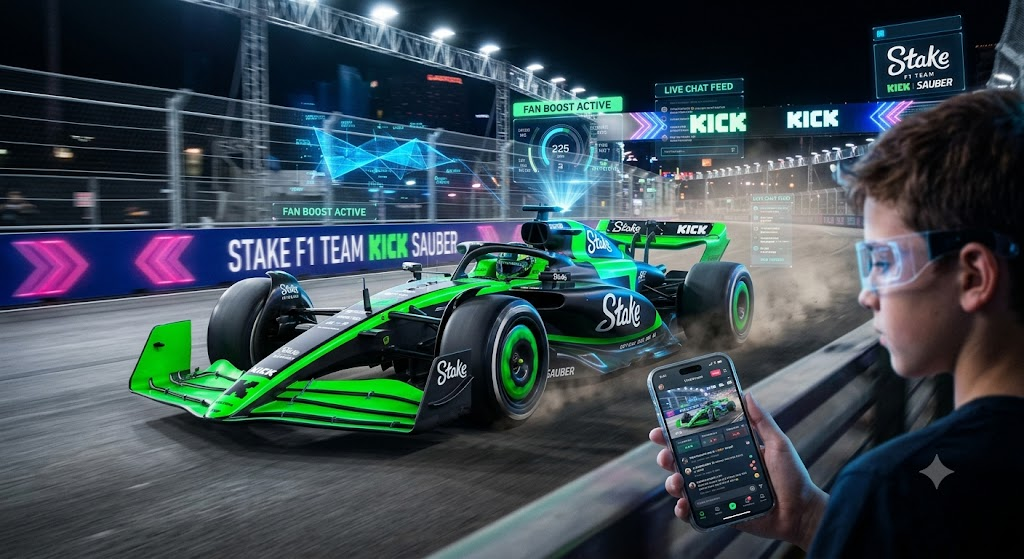
Financial survival in this new demographic coalition requires a total pivot into what the industry calls hyperreality. We are watching the boundary between physical racing and digital entertainment evaporate entirely. This convergence is exactly why the Stake F1 Team Kick Sauber deal structurally rewired the sport. The Swiss organization deliberately fractured its naming and chassis rights across two distinct, highly lucrative platforms: the overarching Stake online casino and Kick.com, a fiercely disruptive streaming service. The catch here is brutal for legacy platforms like Twitch. Kick entices creators with an absurdly generous 95/5 revenue split, weaponizing those influencers to drag millions of Gen Z viewers directly into the motorsport ecosystem.
When international advertising laws block gambling logos, the car simply runs a heavily revised neon green Kick livery. That dual-branding strategy seamlessly bypasses regulatory hurdles while funneling cultural traffic right back to the overarching Stake platform. Teams are essentially building 24-hour digital ecosystems that mirror modern betting interfaces by deliberate design, not by accident. They architect the UI to mimic the rules of live dealer games—unlimited seating, direct eye contact with the human talent, and instant micro-transactions. The digital fan hub operates exactly like a premium casino suite, removing the geographical and financial friction of attending a live race. Passive consumption is financial suicide. Stake F1 Team even partnered with Aleph to accelerate this digital monetization, proving that audience acquisition operates as a continuous, omnichannel war.
Proof of Concept: When Logos Actually Build the Car
A logo slapped on a rear wing is a spectacular waste of capital if the sponsor’s product fails to physically improve the vehicle. Eleven Dynamics AG proved this by integrating their automation suite directly into the Sauber manufacturing process. Manual inspections were aggressively replaced with robotic, real-time measurements. The technology literally builds a faster, tighter car, transforming the sponsorship into a bulletproof B2B case study. Tech sponsors demand this exact type of operational integration today. Enterprise clients will not buy your software on Monday morning if it cannot survive the extreme stress-test of a Formula 1 weekend.
Boardrooms now demand that every massive marketing expenditure also aggressively validates their ESG commitments, pushing the market heavily toward purpose-driven alliances. Consider the DHL and Formula E partnership. The logistics giant leverages the all-electric grid as a high-velocity testing ground to publicly validate its ruthless mandate of achieving net-zero emissions by 2050. A sustainable motorsport property allows these massive B2B organizations to strip away their corporate stiffness and secure highly visible, first-mover legitimacy in the green tech sector.
The 1:1 Activation Trap and First-Party Data
Every single dollar thrown at rights fees now demands a mirrored dollar in activation, creating a brutal 1:1 financial trap for unprepared marketers. Programs trying to cheat this ratio fail miserably. Historically, over three-quarters of Chief Marketing Officers could not even calculate their sponsorship return on investment. The only way to prove ROI today is by abandoning third-party cookies and dragging fans into owned digital platforms.
Formula E figured this out early with FanBoost. Fans voted on social media to give drivers a physical hybrid energy power boost during the actual race. Purists hated the gimmick, yet the 13-to-24-year-old demographic skyrocketed to 45% of the series’ online engagement. The series pushed further by broadcasting live heart rates of drivers, bridging the emotional gap with biometric telemetry.
Brands are no longer merely sponsoring a vehicle; they are actively financing sophisticated data-harvesting operations. Leagues deploy artificial intelligence systems to monitor digital behavior, anticipate crowd movements, and instantly generate highly personalized video feeds for millions of users. This complex machine learning framework guarantees that a corporate asset drops in front of a fan exactly when their adrenaline peaks.
Virtual Liveries, Concrete Profits
These massive data operations are ruthlessly targeting future consumers long before they take a driver’s education course. NASCAR realized the absurdity of waiting for teenagers to discover the sport organically and aggressively launched the “NASCAR Speed Hub” directly inside Roblox. Kids are out there customizing virtual stock cars and completing branded quests years before they possess real-world purchasing power. Formula 1 teams are running the exact same playbook across the gaming world. Virtual McLaren suits and Red Bull helmets are sold for digital avatars on Gran Turismo. When a fan buys a digital Porsche livery, they become a micro-influencer for that brand across the entire virtual economy.
The physical track experience is undergoing a similar digital overhaul. Modern frictionless stadiums utilize facial recognition and wearable credentials to completely eliminate logistical headaches. A sponsor underwriting this environment gets clear attribution for every single transaction, merging the physical and digital payment ecosystems. Frankly, the future of this industry belongs to organizations treating their physical vehicles as mere entry points into a gamified universe. Relying on a traditional Sunday broadcast for your primary impressions is a guaranteed way to bleed capital. Savvy brands are dumping their budgets into round-the-clock esports ecosystems, creator-driven content drops, and hyper-interactive digital arenas. The checkered flag doesn’t end the race anymore; it simply pushes the audience onto a different screen.

Other Articles
Sports Gaming Franchises to Play on Console This Autumn