

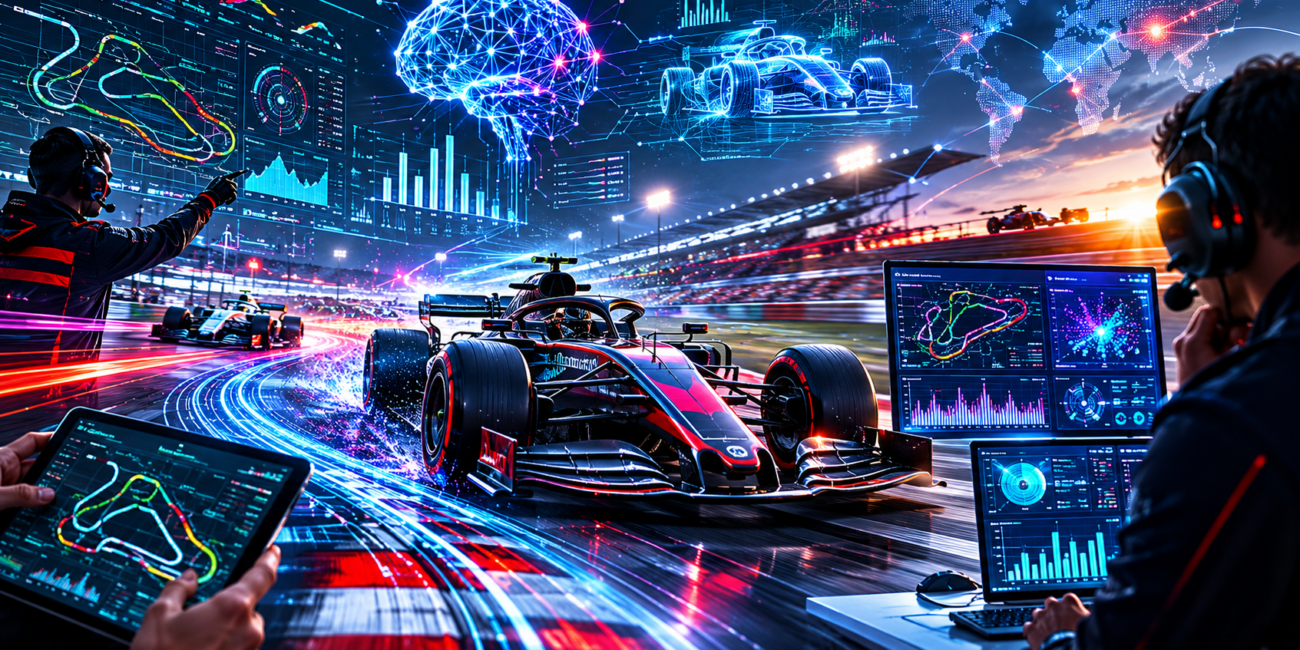
Modern motorsport has always relied on engineering precision, driver skill, and tactical decision-making. Yet in recent years, data analytics has become one of the most influential forces shaping competitive racing across nearly every major motorsport category.
From Formula 1 and endurance racing to touring cars and MotoGP, teams now process enormous volumes of real-time information during every session. Telemetry systems, AI-assisted analysis, predictive modelling, and machine learning tools are fundamentally changing how races are managed, how cars are developed, and how drivers approach performance.
The result is a sport that increasingly resembles a live technological ecosystem as much as a traditional mechanical competition.
The Rise of Real-Time Telemetry
Telemetry has existed in motorsport for decades, but the scale and sophistication of modern systems are vastly different from earlier generations.
Today’s race cars are equipped with hundreds of sensors capable of collecting data on tyre temperatures, brake wear, fuel consumption, suspension movement, aerodynamic balance, steering inputs, throttle application, and countless other variables. During a race weekend, teams generate millions of data points that engineers analyse continuously.
This information allows teams to monitor vehicle performance in real time and respond to problems before they become critical. Engineers can identify overheating components, detect tyre degradation patterns, or adjust race strategies based on changing track conditions within seconds.
In elite motorsport, the difference between victory and defeat is often measured in tenths of a second. Data analytics gives teams the ability to make highly informed decisions at speeds that would have been impossible only a decade ago.
Predictive Strategy Has Become Central to Racing
One of the biggest shifts in modern motorsport is the growing reliance on predictive modelling.
Teams no longer react solely to what is happening on track. Instead, they simulate multiple race scenarios in advance using sophisticated software capable of forecasting tyre performance, pit-stop timing, fuel strategy, and weather impact.
These predictive systems can calculate thousands of possible race outcomes during an event. If a safety car appears, for example, teams can instantly model whether pitting immediately or staying out will provide a competitive advantage later in the race.
This has made race strategy significantly more dynamic. Motorsport is no longer driven purely by instinct and experience; it increasingly depends on computational analysis and probability modelling.
Artificial intelligence is also beginning to influence strategy development. Some systems can analyse historical race data and identify tactical patterns that human engineers may overlook. While human decision-makers remain central, AI-assisted analysis is becoming an increasingly valuable support tool.
Driver Performance Is Analysed in Extraordinary Detail
Modern data systems are not limited to vehicle performance. Drivers themselves are now analysed with remarkable precision.
Telemetry can reveal how aggressively a driver applies throttle, how consistently braking points are hit, and how steering inputs change over the course of a race stint. Engineers compare these patterns against ideal reference laps to identify areas for improvement.
This level of analysis has transformed driver coaching and development. Rather than relying entirely on subjective feedback, teams can now pinpoint precise technical adjustments that may improve lap times.
Simulator technology has accelerated this trend further. Drivers regularly spend hours in advanced simulators that replicate real-world circuits using detailed performance data gathered from previous races. These environments allow teams to test setups and strategies before cars even arrive at the track.
The relationship between driver and engineer has therefore become increasingly collaborative and data-driven.
Motorsport Is Becoming a Technology Showcase
The influence of analytics extends beyond racing itself. Motorsport has long acted as a testing ground for automotive innovation, and modern data systems are now influencing the wider automotive industry.
Technologies developed in racing environments often filter into road cars over time, particularly in areas such as efficiency, safety systems, predictive maintenance, and connected vehicle software.
This wider digital transformation is changing how enthusiasts engage with performance culture as well. Increasingly, motorsport fans are interested not only in mechanical engineering but also in software strategy, telemetry interpretation, and digital innovation.
The broader automotive world has seen a similar shift toward personalisation and identity-driven ownership. Across enthusiast communities, companies like Plates Express reflect the growing importance motorists place on presentation and individuality alongside technical performance.
Data Is Changing the Spectator Experience Too
The rise of analytics has also reshaped how audiences experience motorsport.
Modern broadcasts now feature live tyre predictions, strategy simulations, timing gaps, and real-time telemetry overlays that give viewers deeper insight into race dynamics. Fans are increasingly able to understand not just what is happening on track, but why teams are making particular decisions.
This analytical layer has added a new dimension to motorsport viewing. Strategy discussions now play a much larger role in fan engagement, particularly in categories where tyre management and pit-stop timing are crucial.
Social media and second-screen viewing habits have amplified this trend further. Many fans actively follow live data feeds, strategy tools, and telemetry analysis during races, creating a more interactive and technically informed audience.
As a result, motorsport culture itself is becoming more data literate.
Human Instinct Still Matters
Despite the growing importance of analytics, motorsport remains deeply human. Data can guide decisions, but it cannot fully predict the unpredictability of racing.
Changing weather, driver psychology, mechanical failures, and split-second reactions still shape race outcomes in ways algorithms cannot completely control. Experienced engineers and drivers continue to rely heavily on instinct, judgement, and communication under pressure.
In many ways, the most successful teams are those that combine advanced analytical capability with strong human decision-making. Data provides information, but interpretation remains critical.
This balance between technology and instinct is likely to define the future of competitive racing.
The Future of Motorsport Strategy
Data analytics is no longer a supporting tool in motorsport — it has become central to how modern racing operates.
Telemetry, predictive modelling, AI-assisted strategy, and real-time performance analysis are transforming everything from race preparation to live decision-making. Teams now compete not only through engineering and driving talent, but also through computational intelligence and data interpretation.
As technology continues to evolve, motorsport will likely become even more connected, adaptive, and analytically sophisticated. Yet the essence of racing remains unchanged: the pursuit of marginal gains in an environment where every decision matters.
The difference today is that many of those decisions are increasingly shaped by data flowing at extraordinary speed behind the scenes.